How to edit the custom dictionary in Word 2007 for misspelled words

If you have added a misspelled word accidentally to Word’s dictionary and still wondering how to delete the erroneous entry, then please read on:

The Procedure

(In this procedure, we are going to edit the Word’s CUSTOM.DIC dictionary)

  1. Click the Office button Picture1; a drop-down list appears.
  2. From the bottom of the drop-down list, click the Word Options button. The Word Options dialog box appears.
  3. Click the item Proofing from the left hand side pane.
  4. Now under the section When Correcting Spelling in Microsoft Office program, click the Custom Dictionaries button. The Custom Dictionaries dialog box appears.
  5. From the Dictionary List, select the CUSTOM.DIC dictionary.
  6. Click the Edit Word List button available on the right hand side of the dialog box. The CUSTOM.DIC dialog box appears.
  7. Using this dialog box, you can search a misspelled word and delete the same; and then enter the correctly spelled word.

How to change default font, font size, margins, etc. in Microsoft Word 2007

If you are wondering how to change the default settings of a Word document (page layout, font size, font type, margins, paragraph  spacing, page border, etc.) then read on.

Every time you open a new Word document, a copy of the default Word template is displayed (as document 1, document 2, etc.)

The name of the default template is Normal.dotm (the .dotm is an extension for macro enabled word template document). The Normal.dotm file exists in the Templates folder.

To locate the Template folder, do the following:

  1. Click the Office Button and click Open (or “Ctrl+O”). The Open dialog box appears.
  2. From the Look in folders (available on the left hand side of the dialog box), click the Trusted Templates folder.
  3. Locate the file Normal.dotm and double-click to open.
  4. The edits you save in this document will be reflected next time you open a new Word document.

template folder

To change default font, font size, font type, font color, etc. in the Normal.dotm

  1. While your Normal.dotm document is open, from the Word Ribbon, click the Home tab. Under the group Styles, click the dialog box launcher icon  available on the right bottom corner. The Styles gallery dialog box appears.
  2. From the Styles gallery, select the style element Normal. Click the down arrow button on the right hand side.
  3. From the drop-down menu, click Modify. Modify Style dialog box appears. Under the section Formatting, change font, font size, font type, font color, text alignment, line space, paragraph spacing, paragraph indenting, etc.
  4. To make advance changes, click the Format button available at the left bottom corner of the Modify Style dialog box.

To make changes in the page margins

  1. While your Normal.dotm document is open, click the Page Layout tab. Now, within the group Page Setup, click the dialog-box launcher icon available on the right bottom corner. The Page Setup dialog box appears.
  2. Click the tab Margins in the dialog box.
  3. Under the section Margins, edit  the  left, right, top and bottom margins.

How to format a Table of Content in Word

A Table of Content can be formatted easily to make it more presentable. Font, font size, line space, etc. in a Table of Content can be controlled from the Styles gallery.

Procedure

  1. Open your Word document.
  2. On the Word Ribbon, click the Home tab.
  3. Within the group Styles, click the dialog box launcher icon dialog box launcher on the right bottom corner. The Styles dialog box is displayed.
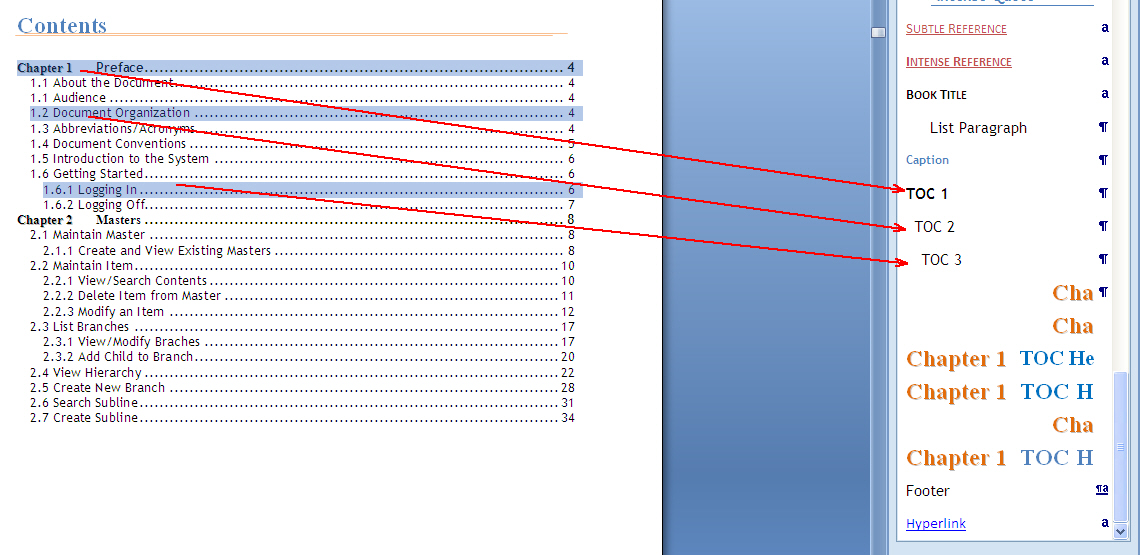
  4. If your document has a Table of Content generated automatically, you can find the style controls TOC1, TOC2, etc. in the Styles dialog box for the corresponding heading levels 1, 2, etc. in the Table of Content (i.e. TOC1 represents first level heading, TOC2 second level heading, and so on.
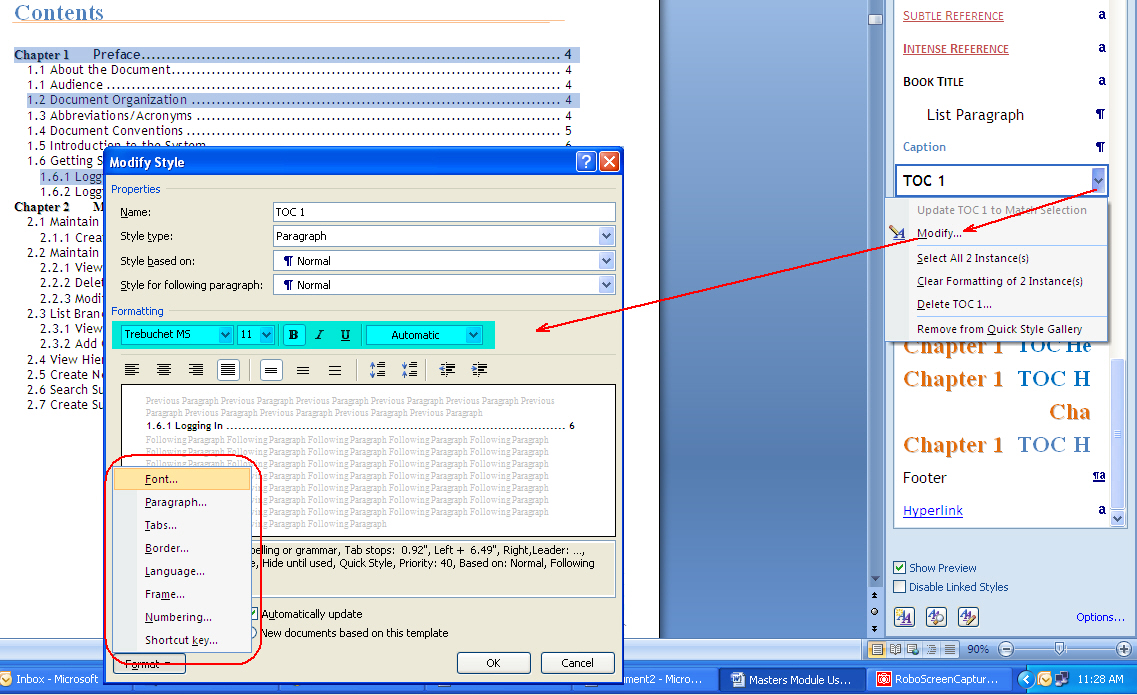
  5. To change the format of the first level heading in the Table of content, hover the mouse cursor over the style control TOC1. TOC1 is highlighted with a surrounding square box and a down-arrow button on the right.
  6. Click the down arrow button. A drop-down list appears.
  7. Click the Modify from drop-down list. The Modify Style dialog box appears. Here, you can edit font, font size, character type, color, etc.
  8. If you want to edit even the paragraphs, border, tab related properties then click the Format button available at the bottom left corner and select a format type from the drop-down to edit.

You can also visit the following article to learn more about updating and formatting table of contents:

https://wordknowhow.wordpress.com/2013/03/28/updating-and-formatting-table-of-contents/

To create a table of content automatically, visit the following article in my blog:

https://wordknowhow.wordpress.com/2013/03/26/how-to-create-a-table-of-contents-automatically-in-word/

How to manage images in Word

If you are having a tough time managing images in your document, the following tips will surely help you.

Majority of the time, we want the images in the document to stick at a fixed position. Images that float are hard to manage.

To fix an image at a certain position in the document

  1. Click the image. The Picture Tools menu group is enabled in Word Ribbon.

in line with text

  1. On the Format tab under the menu Pictures Tools , within the group Arrange, click the drop-down list button Text Wrapping.
  2. Click In Line with Text from the drop-down list. The selected image will be fixed at a line in the document.
  3. You can click and drag the image to a different line in the document.
  4. To place the image at a different position horizontally, place the mouse cursor in front of the image and then use Tab or Space Bar to move the  image horizontally to a new position.

To wrap text around an image

  1. Select the image.
  2. On the Format tab under Pictures Tools menu, within the group Arrange, click the drop-down menu Text Wrapping .
  3. Select Square from the drop-down list. Text will be arranged around the image in the shape of a square.
  4. If image has an irregular shape (such as a star), click Tight from the drop-down list. Text takes the shape of the image around it.

Note:  If the image inserted has an irregular shape (such as a star), select the option Tight to arrange text around the shape.

How to add caption to a figure in Word and insert a new Label for a caption

To add a caption in Word

  1. From the Ribbon, click the tab References.
  2. On the References tab, within the menu group Captions, click Insert Caption (keyboard shortcut key: Alt+S+P). The dialog box Caption appears.
  3. Select a caption label from the drop-down list Label (default labels are Equation, Figure, and Table).
  4. Enter a caption next to the label in the Caption field.
  5. Click OK.

insert caption

To insert a new Label

  1. On the Caption dialog box, click the button New Label.
  2. Enter the new label name in the New Label pop-up window.
  3. Click OK. the New label is added to the drop-down list Label.

How to remove Header and Footer from part of a document

If you remove header/footer from a page of a Word doc, header/footer from the entire document disappears. Similarly, if you insert header/footer to a page, the same is copied to entire pages of the document. This is how header/footer supposed to work.

Now, if you need to apply unique header & footer to a page or part of a document other than the rest of the document, how will you do that?

The trick lies in separating the pages which would have unique header/footer from the rest of the document using Section Breaks. The separated sections can be applied with unique formatting and styling.

For example, suppose the pages 5 to 7 in your document to have a unique header/footer than the rest of the document.

The Procedure

  1. Insert Section Breaks at the end of the pages 4 and 7. This way, you have divided the document into three sections. To insert a Section Break, do the following:
  2. From the Word Ribbon, click the tab Page Layout and then click Breaks under the group Page Setup. From the drop-down list, click Next Page under Section Break. See below screen.

insert section break

  1. Now on the 5th page, enable the header/footer sections by double clicking the top/bottom of the page respectively. The Header & Footer Tools tab is enabled on the Word Ribbon.
  2. From the Header & Footer Tools tab, under the group Navigation, click the Link to Previous icon link to previous icon to de-link the current section from the previous section. This is the key step of the procedure.
  3. Now, enter new header/footer content on the 5th page.
  4. Similarly, enable the header/footer section on the 7th page and click the Link to Previous icon to disable the linking between current and previous sections. On this header/footer, you can repeat the header/footer of the first section.

Please go through the following article to understand how to remove header and from the first page:

https://wordknowhow.wordpress.com/2013/04/04/how-to-remove-header-and-footer-from-the-first-page-of-your-word-document/

How to remove header and footer from the first page of your Word document

This is super easy.

The Procedure

  1. Open your Word document.
  2. From the Ribbon, click the Page Layout tab.
  3. On the Page Layout tab, click the Page Setup dialog-box-launcher icon dialog box launcher. The Page Setup dialog box appears. See the screenshot below.

remove header and footer frist page

  1. From the Page Setup dialog box, click the Layout tab.
  2. On the Layout tab, under the section Headers and Footers, select the “Different first page” check box.
  3. Click OK. You are done.

Updating and Formatting Table of Contents

Updating Table of Contents

After creating a Table of Contents if you had made changes to the document and wish to update the Table of Contents accordingly, do the following:

  1.  Right-click on the Table of Contents
  2. From the right-click menu, click Update Field. Update Table of Contents dialog box appears.
  3. Select the option Update Entire Table
  4. Click OK.

See below image:

update table of content

Formatting Table of Contents

You can modify the appearance of a Table of Contents by formatting the text in the table of contents.

    1. View the default styles for each heading level in the Styles gallery. To open the Styles gallery widget, click Alt+O+S. See below image:

format table of cotents1

  1. Click the down arrow button next to a style in the gallery, click Modify. Modify Style dialog box appears.
  2. In the Modify Style dialog box, you can modify properties such as font, paragraph, tabs, border, for each heading level in the Table of Contents.

See below image:

format table of cotents2

How to create a Table of Content automatically in Word

Creating a table of content automatically in Word involves the following two steps:

Step 1:

1.    Identify the texts in your document that you intend to highlight as headings and then apply appropriate heading styles from the Styles gallery.

For example, to apply  first level heading, select the text in your document and then click style Heading 1 from the Styles gallery. See below:

table of content1

(To learn more on how to create and apply multilevel heading styles in your document, read the following post:

https://wordknowhow.wordpress.com/2013/01/30/how-to-use-multilevel-numbered-headings-in-the-word/)

Step 2:

Once you are done applying  heading styles to all the heading levels in your document, place the mouse cursor where you want to generate the table of content.

Click the Reference tab from the Ribbon and then under group Table of Contents, click the icon Table of Contents. From the bottom  of the drop-down list, click Insert Table of Contents See below image:

table of content2

On clicking Insert Table of Contents, the dialog box Table of Contents appears. Now, do the following in the dialog box:

  1. Select a Tab Leader type from the drop-down list.
  2. Select a format for the table of content from the drop-down list Formats.
  3. Select the number of heading levels to be included in the table of contents from the Show Levels spin box.
  4. Click the Options button from the right bottom corner to include/exclude heading styles to build a customized table of content.

See below image:

table of content3

Click OK. Table of Content is generated in the cursor position.

( To learn more about how to update and format a Table of Contents in Word read the following article:

https://wordknowhow.wordpress.com/2013/03/28/updating-and-formatting-table-of-contents/ )

How to create multilevel lists in Word

Creating and fixing multi-level numbered headings in Word might seem to be a bit tricky for the first time users. Nevertheless, if you know the correct procedure, it would be a piece of cake!

Note: If you’ve already created a list, but ran into a problem, read this to fix your list: https://wordknowhow.wordpress.com/2013/05/20/how-to-fix-multilevel-list-in-word/

Follow the steps stated below to create a new multilevel numbered list the correct way:

The Procedure

Firstly, we will define the multilevel numbering for the heading levels using Multilevel List feature.

1.     Open the Word document in which you want to apply numbered headings.

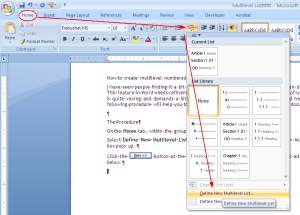
2.     From the Word Ribbon menu, under the tab Home and within the group Paragraph, click the Multilevel List icon multi list button .  A drop-down menu appears.

(Click the image to view in full screen)
define new multi level list

2.     From the drop-down menu, select the option Define New Multilevel List (at the bottom of the menu). The “Define New Multilevel List” dialog box pops up.

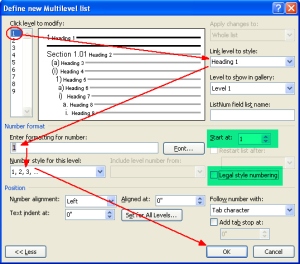
3.     Click the More button  (Picture1)  available at the bottom of the dialog box. The dialog box expands to show additional fields (see below image).
define new multi level list dialog
Create First Level Heading   (or define number format for the first level heading)

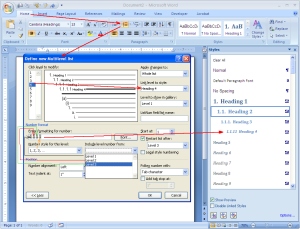
4.     Click level “1” from Click level to modify selection box (on the top left hand side of the dialog box).

5.     From the drop-down list named Link level to style, select “Heading 1”.  This way, you are linking heading level “1”  (that you will use in your document) to Word’s default Heading 1 style from the Styles gallery. Later, you can modify style for each heading as you wish.

6.     In this step, enter a numbering format for your heading level 1 in the field Enter formatting for number from the drop-drop-down list Number style for this level. So, the format you select from the drop-down list will appear in the Enter formatting for number field. You can delete the default number format appearing in the Enter formatting for number field and choose your own.

Important:
a.    You can reset the value in the Enter formatting for number field by selecting a value from the spin box Start at.
b.    If you find the field Number style for this level as disabled, clear the check box Legal style numbering.
Creating Second Level Heading

7.     Similarly, select level “2” from Click level to modify selection box.

8.     Link level 2 to Word’s default Heading 2 by selecting “Heading 2” from the Link level to style drop-down list.

9.     Delete whatever appears (by default) in the field Enter formatting for number to apply a new number format. From the field Include level number from, select Level 1 (as a prefix) for the second level heading. Apply a dot (.) or anything you would like after the prefix number. I prefer a dot.

10.     After a dot (.)select a numbering format for the Level 2 heading (e.g. 1.1). You are done.

11.     Similarly, you can keep adding levels as needed. While creating the third heading, select Level 1 and Level 2 headings as prefixes from the Include Level Number from field and then select a number format for the Level 3 heading (e.g. 1.1.1 ).

The following example shows how to construct the Heading level 4.
untitled
Once you are done with defining number format for all the headings, you can view the same being updated in the Styles gallery, under the tab Home, within the group Styles in the Ribbon. Or, you can open the Styles window by pressing Shift+Ctrl+Alt+S.

Now, select text in your document (which you want as a heading) and then click the relevant heading style (which you have just created) from the Styles gallery.

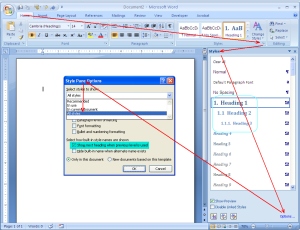
Please note that you may not see all the  multilevel heading levels (that you have just created) in the gallery depending on the configuration of the Style Pane Options. You can open the Style Pane Options dialog box by clicking the Options link available at the bottom of the Styles gallery pane. See below image.
untitled

The Style Pane Options window appears. Click Select styles to show drop-down list and select the option All Styles from the list. Click OK. Now you can view all the 9 heading levels with multilevel numbering in the Styles gallery.
Modify the appearance of the headings

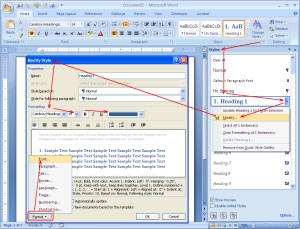
You can modify the style (font, numbering, etc.) of the headings from the styles gallery by selecting Modify from the right-click menu of each heading and then clicking the Untitled button from the Modify Style dialog box.

For example, if you want your Heading 1 to have font “Cambria”, font size “14”, Bold, color Blue then configure these in the Modify Style dialog box as shown in the following screenshot.
untitled

You can also apply these style by clicking the Format  button available at the bottom of the Modify Style dialog box and then clicking the Font from the sub-menu. This will display the Font dialog box where you can apply font styles for Heading 1.

Similarly, you can modify other properties of the headings by selecting the appropriate options from the Format sub-menu.

Please let me know in the comment section if you have any difficulty understanding the procedure or if you have any other queries, suggestions, etc. I will be more than happy to help you out! Thank you.

The following post could also be helpful to you:

https://wordknowhow.wordpress.com/2013/05/20/how-to-fix-multilevel-list-in-word/